You do not need a complicated recipe to make your morning coffee more consistent. Start by measuring how much coffee and water go into the brewer, then change one thing when the cup does not taste right.
A practical starting point for hot filter coffee is 1:16: 1 gram of ground coffee for every 16 grams of water. That means 20 g coffee with 320 g water, or about 320 mL. The chart below lets you scale that starting recipe without guessing what a brewer means by a “cup.”
These are starting points, not a universal best ratio. Your beans, grind, brewer and taste all matter. The ratio describes the ingredients going in—not the amount of finished coffee coming out.
What does a coffee-to-water ratio mean?
In a ratio written as 1:16, the first number is dry ground coffee and the second is brewing water, both measured by weight. For ordinary kitchen calculations, 1 mL of water is approximately 1 g. This makes a measuring jug useful if your scale cannot hold the full brewer.
- 1:15: more coffee for the same water; a more concentrated starting mix.
- 1:16: a useful middle starting point for hot filter coffee.
- 1:17: less coffee for the same water; a less concentrated starting mix.
A smaller second number means more coffee relative to water. For 300 mL water, 1:15 needs 20 g coffee, while 1:17 needs about 17.6 g. The lower ratio is not automatically tastier, better extracted or higher in caffeine by a fixed amount.
Coffee-to-water ratio chart
Choose the amount of water you will add, then read across. Coffee amounts are rounded to the nearest 0.1 g; rounding to the nearest whole gram is also reasonable for everyday brewing.
| Water added | 1:15 coffee | 1:16 coffee | 1:17 coffee |
|---|---|---|---|
| 180 mL | 12 g | 11.3 g | 10.6 g |
| 240 mL | 16 g | 15 g | 14.1 g |
| 300 mL | 20 g | 18.8 g | 17.6 g |
| 320 mL | 21.3 g | 20 g | 18.8 g |
| 500 mL | 33.3 g | 31.3 g | 29.4 g |
| 750 mL | 50 g | 46.9 g | 44.1 g |
| 1,000 mL | 66.7 g | 62.5 g | 58.8 g |
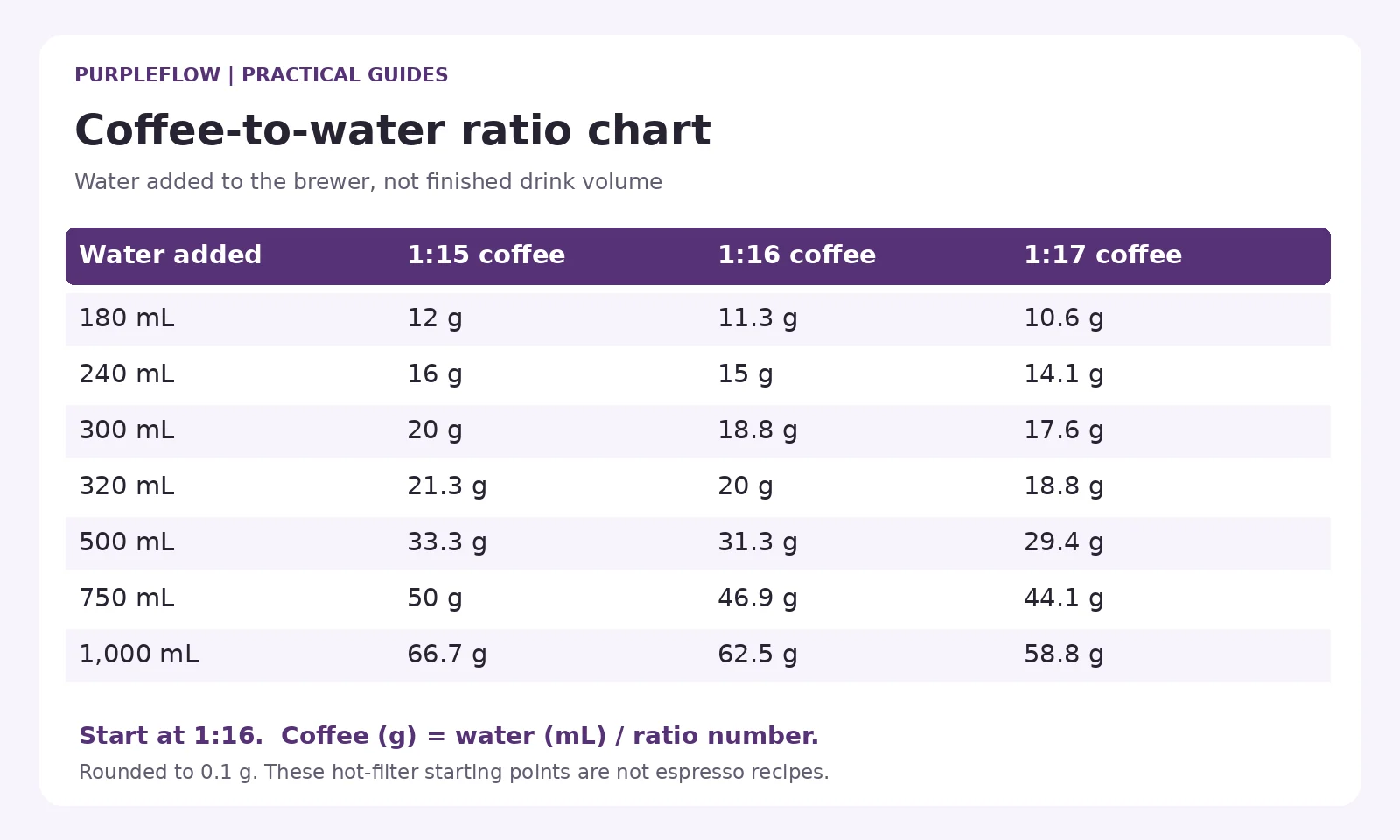
Download the printable coffee ratio chart (PDF), or use the free ratio calculator and brew log (XLSX). Enter your water amount and ratio to calculate coffee; a second box calculates water from a coffee dose. No email or purchase is required.
A starting ratio for your brewer
| Method | Try first | Example | Important distinction |
|---|---|---|---|
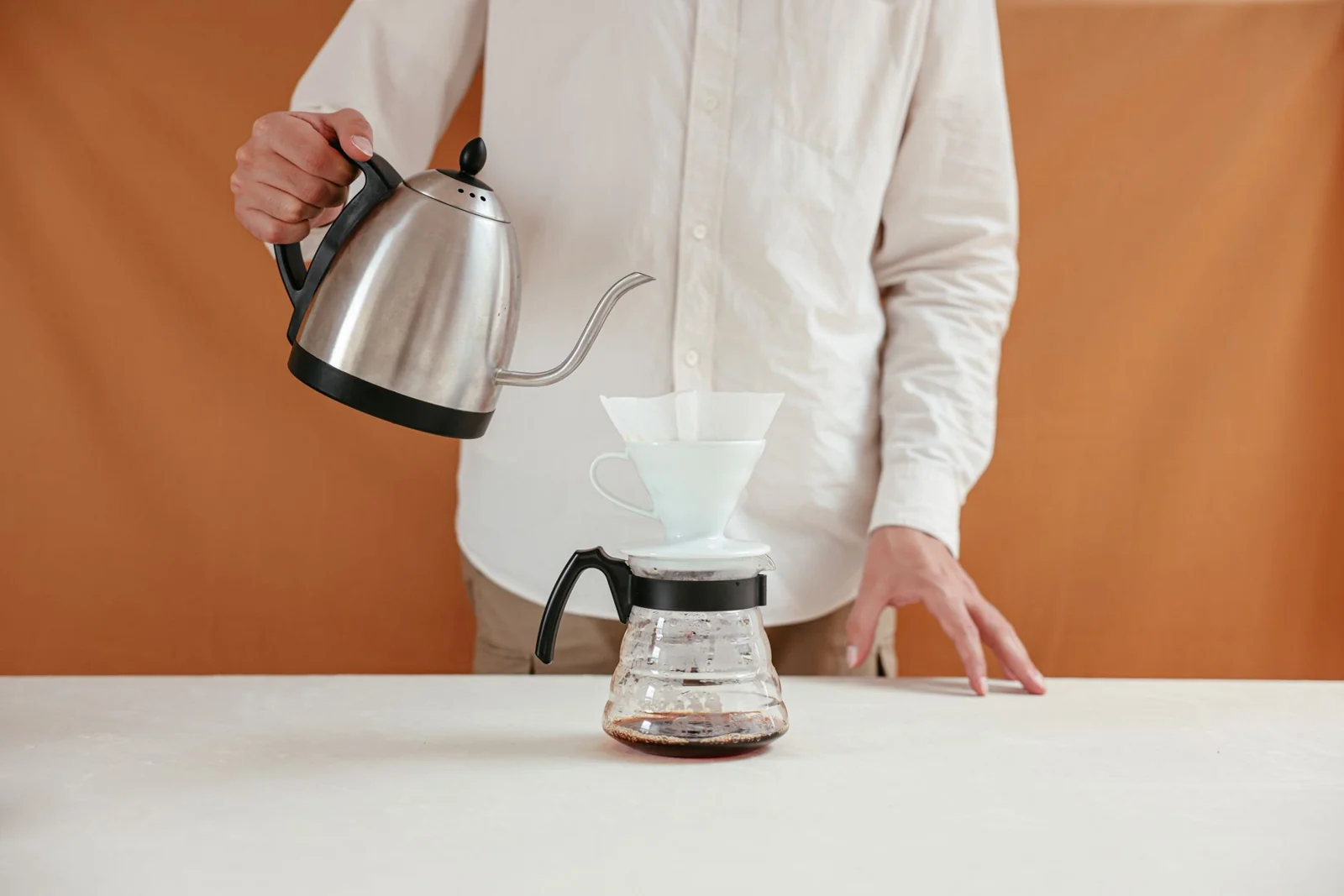
| Pour-over | 1:16 | 20 g coffee + 320 g water | Total poured water includes the bloom. |
| Automatic drip | 1:16 | 31 g coffee + 500 mL water | Check your machine’s instructions, reservoir and basket capacity. |
| French press | 1:15 | 20 g coffee + 300 g water | Use a suitable grind and decant after brewing. |
For a concrete manufacturer example, Baratza’s V60 guide uses 20 g coffee and 320 g water—a 1:16 input ratio. That is an example recipe, not proof every pour-over should use the same grind or timing.
The National Coffee Association’s French press guide gives a broader 1:10–1:16 range. Our 1:15 suggestion is a place to begin within that range. Taste your own brew before deciding to make it stronger.
Do not apply this hot-filter chart directly to espresso, moka pots or cold brew concentrate. Espresso recipes commonly compare dry coffee with beverage yield, while a concentrated cold brew may be diluted after brewing. For the method differences, see our French press vs. pour-over guide and cold brew vs. iced coffee comparison.
Grams, milliliters and cups: avoid the common mix-up
A US customary measuring cup holds approximately 237 mL. Some metric measuring cups hold 250 mL. A coffee machine’s “cup” marking may be smaller than either. Check the manual instead of multiplying a machine’s cup count by your mug size.
For example, four US measuring cups of water are about 946 mL. At 1:16, that calls for about 59 g coffee. Four 250 mL metric cups are 1,000 mL, calling for about 63 g. Neither calculation tells you what a machine labelled “four cups” holds.
Grounds retain some water and brewing can lose water through evaporation or the equipment. Therefore, 320 g water added will usually produce less than 320 g finished drink. If you need to fill a particular mug, measure the output of your normal brew, then scale the next batch without exceeding the brewer’s capacity.
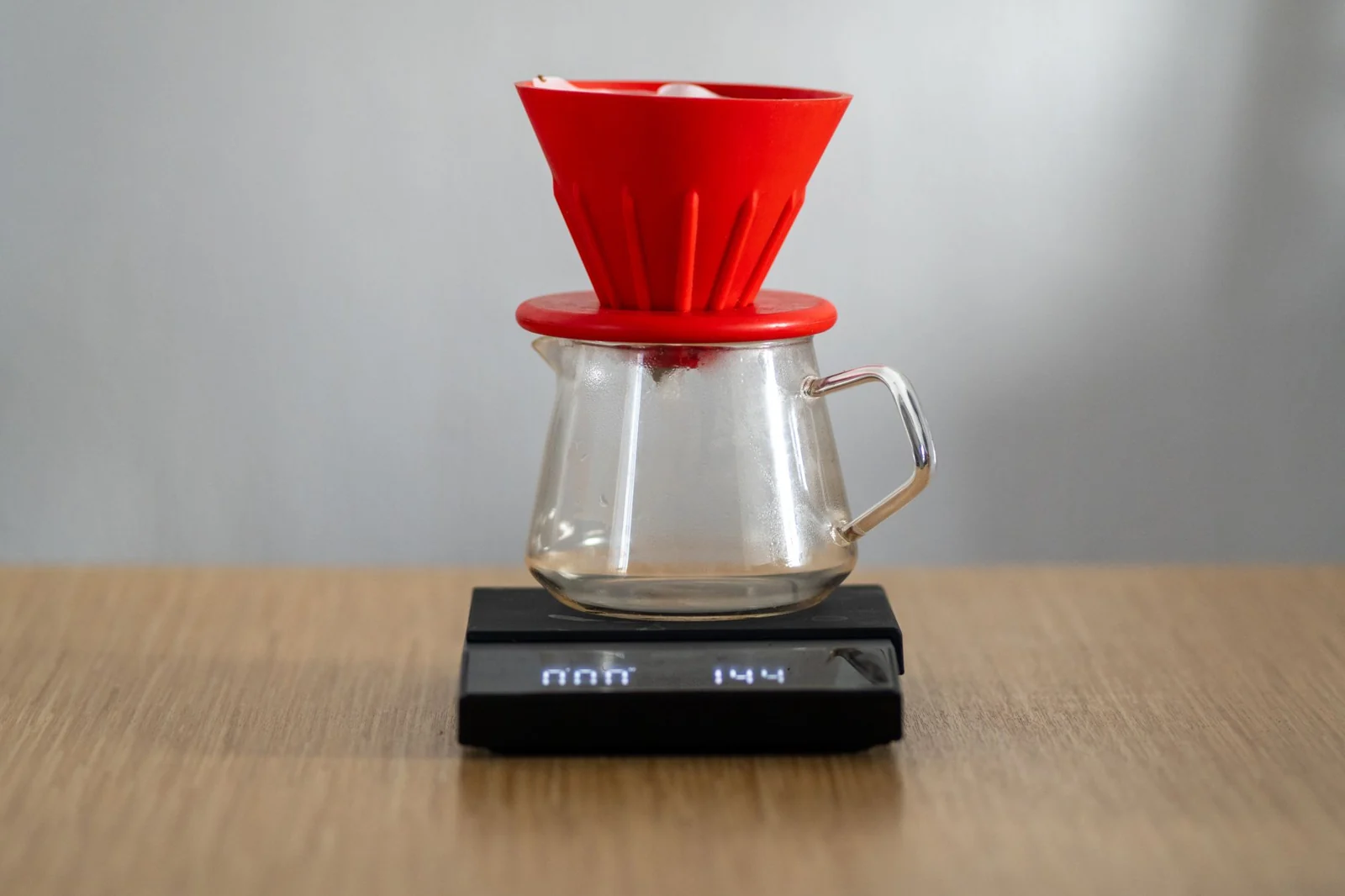
An easy first pour-over: 20 g coffee, 320 g water
Use a heat-safe mug or carafe, a suitable dripper and filter, and a stable scale if you have one. Keep hot water and equipment away from the edge of the counter.
- Measure the coffee. Weigh 20 g of ground coffee. Begin with a grind suited to your dripper or the coffee seller’s recommendation.
- Prepare the brewer. Fit the filter correctly. If you rinse it, discard that rinse water before starting the measured brew.
- Wet the grounds. Add about 40 g water to wet the coffee, and wait about 30 seconds. This water counts toward the 320 g total.
- Finish the pour. Add the remaining water in controlled pours until the total added reaches 320 g. You are not adding another 320 g after the bloom.
- Let it drain and taste. Note the result once it is cool enough to sip. Record your dose, total water and one sentence about the flavor.
This is a simple starting recipe adapted from the dose and bloom quantities in Baratza’s guide. Brew time and pouring details depend on the dripper, filter and grind. Do not force a good-tasting cup to match someone else’s timer.
No scale? Make your scoop method repeatable
A tablespoon measures volume, not coffee weight. Different grinds, roasts and heaped scoops can hold different masses, so a fixed “grams per tablespoon” conversion is unreliable.
The National Coffee Association’s drip guide suggests a broad starting range of 1–2 tablespoons per 6 US fluid ounces of water, about 177 mL. That is a scoop-based guideline, not an exact equivalent of the weight chart.
Use the same level scoop, the same coffee and a measured water amount. Write down the combination. If a kitchen scale is available later, weigh several of your normal level scoops together and divide by the number of scoops to estimate your own average. There is no need to buy a specialized coffee scale just to begin.
Fix the cup by changing one variable
| What you notice | What to try next |
|---|---|
| Flavor is pleasant, but too concentrated | Add a small amount of hot water to the finished cup. Next time try 1:17 while keeping the brewing method consistent. |
| Flavor is pleasant, but too diluted | Try 1:15 next time. Keep the same coffee, grind and water amount while increasing the dose. |
| Sharp or sour, with a thin finish | Do not assume more coffee is the answer. Check for uneven wetting and try one small grind adjustment, such as slightly finer for a fast-draining pour-over. |
| Bitter, drying or unusually slow to drain | Check for stalled flow and try a slightly coarser grind or gentler pouring. A darker roast may also taste bitter even when brewing is consistent. |
Strength and extraction are different. Strength is the concentration of the drink; extraction concerns what brewing removes from the grounds. Diluting a bitter cup makes it less concentrated, but does not reverse the extraction that already happened. Likewise, a sour cup is not automatically a weak-ratio problem: roast, water and your taste preferences can contribute.
Frequently asked questions
How much coffee do I need for 500 mL water?
At 1:16, divide 500 by 16: 31.25 g, or about 31 g. Use about 33 g for 1:15 or 29 g for 1:17.
Is 1:16 the same as 16 g coffee per cup?
No. It means 16 g water for each 1 g coffee. With 240 mL water, that is 15 g coffee. The coffee dose changes with the water amount.
Does the bloom count as part of the water?
Yes. In the 20 g / 320 g example, a 40 g bloom leaves 280 g water to add.
Can I double the recipe?
You can double the ingredient amounts, but first check the brewer’s capacity. A larger coffee bed can change flow and brew time, so taste and adjust rather than assuming an identical result.
Keep the next brew simple
Choose one water amount, use 1:16 for your first hot-filter brew, and record what you used. Keep the printable chart near your brewer and change only one variable next time. A repeatable cup you enjoy is more useful than chasing a supposedly perfect number.
Illustrative photos via Pexels: Cup of Couple, Israyosoy S.. Ratio chart: Purpleflow.
Purpleflow publishes informational content, not personal medical advice. See our wellness disclaimer and editorial policy.