
A useful evening routine for busy adults has three jobs: stop carrying work into the night, make tomorrow a little easier, and leave time to unwind. You do not need a spotless kitchen, a long skincare ritual, or a perfect bedtime checklist. Choose the 5-, 10-, or 20-minute version below and stop when the timer ends.
This is a practical work-to-bed transition, not a treatment for insomnia. The timings are flexible planning ideas, not clinically tested sleep prescriptions.
What should I do in a 20-minute evening routine?
First decide when your wind-down starts, working backward from a realistic bedtime. Run this routine before that quieter period—not instead of it. If it would push bedtime later, use the shorter version.
On a phone, swipe the table sideways to see all columns.
| Time | Action | What “done” looks like |
|---|---|---|
| 0–3 minutes | Close the work loop | Write tomorrow’s first task and one reminder. Close the laptop or silence nonessential work alerts. |
| 3–8 minutes | Reset one small area | Clear the breakfast space or load a few dishes. Do not start a whole-house clean. |
| 8–13 minutes | Remove morning friction | Put out clothes, check your keys, and choose breakfast. Pick two jobs, not ten. |
| 13–20 minutes | Switch to something quiet | Wash up, read a few pages, or sit without work. Choose the option that feels restful to you. |
Example: If your target bedtime is 10:30 p.m., you could reset from 9:10 to 9:30 and keep the remaining hour quieter. This is an example, not a required schedule. Hygiene, medication, caregiving, and essential tasks take priority over the timer.

Only have 5 or 10 minutes? Keep the same three jobs
A shorter routine is not a failed longer routine. It is the right-sized version for tonight.
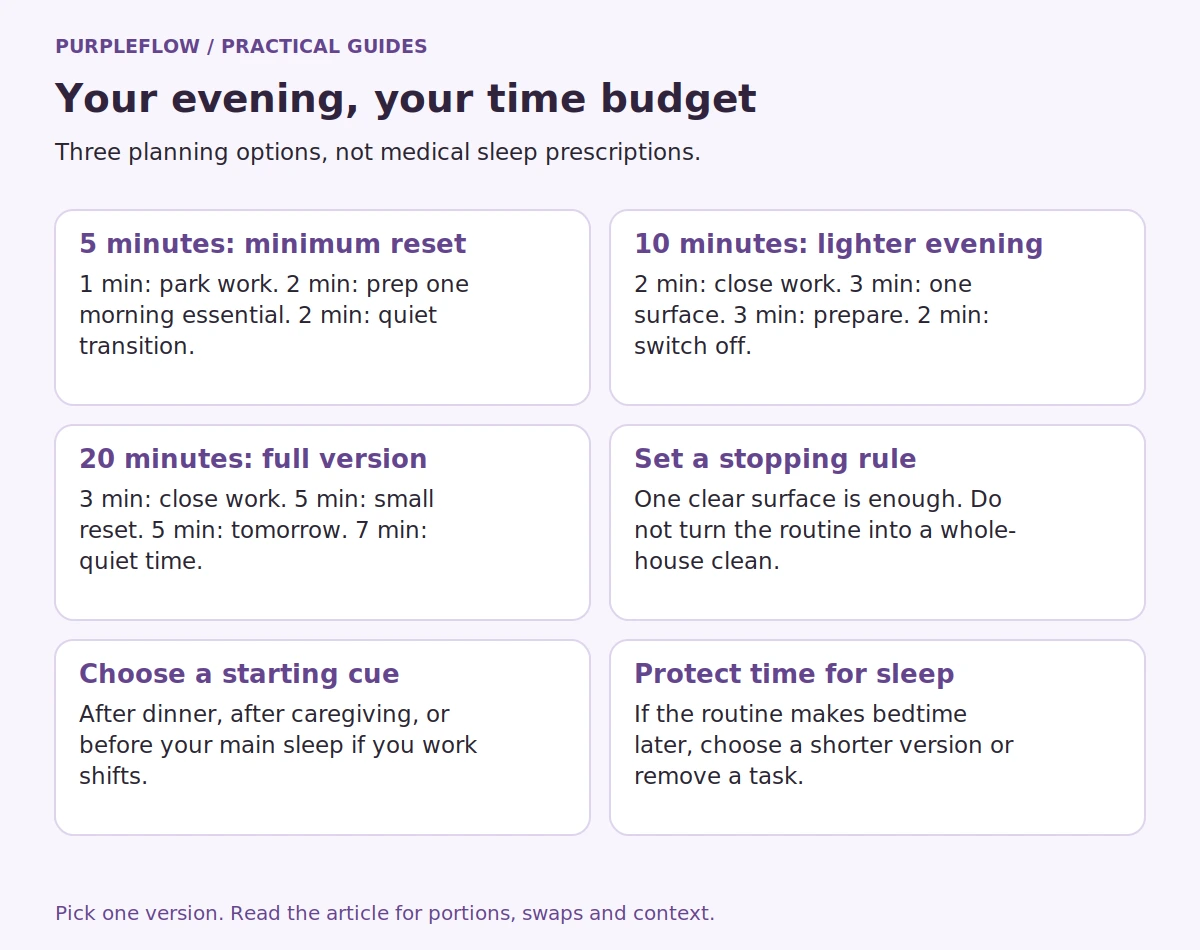
- 5 minutes: One minute to write the next work task, two to prepare one morning essential, and two for a quiet transition.
- 10 minutes: Two minutes to close work, three to reset one surface, three to prepare tomorrow, and two to switch off.
- 20 minutes: Use the four-step plan above: 3 + 5 + 5 + 7 minutes.
Save the routine card to your phone or use the free printable evening checklist. Circle one version in advance so you do not negotiate with yourself when you are tired.
Make it work with children, late shifts, or unfinished chores
When the house is still busy
Attach your reset to something that already happens: after dinner, after the children’s bedtime, or after your final household task. Share one clear job with another adult if possible. If quiet is unavailable, start with the practical steps and save the quiet transition for later.
When you finish work late
Use the five-minute version and protect your opportunity to sleep. For shift workers, “evening” means the period before your main sleep, even if that falls in the morning. Avoid copying a 9 p.m. routine that does not fit your life. NHLBI has specific sleep-habit suggestions for shift workers, including reducing light and noise during daytime sleep.
When chores keep expanding
Name one stopping rule: “The breakfast counter is usable” or “Tomorrow’s clothes are ready.” Put nonurgent chores on a list for another time. If a safety-critical or essential task needs finishing, do it; shorten the optional routine rather than your sleep time.
For a wider look at competing commitments, use our guide to building a more balanced lifestyle. This evening reset is just one small piece of that picture.
What helps the wind-down—and what makes it harder?
NHLBI’s healthy sleep guidance supports quieter time before bed, a consistent sleep schedule, and a cool, dark, quiet bedroom. A routine cannot guarantee that you will fall asleep.
- Keep: a short list, a clear stopping point, and an enjoyable quiet activity.
- Move earlier: big planning sessions, intense exercise, and demanding chores if they make it harder to wind down.
- Notice: late caffeine and alcohol rather than treating them as wind-down tools. NHLBI notes caffeine effects can last up to eight hours; sensitivity varies.
- Reduce: bright screens and work notifications during your quieter period. If a phone is necessary, avoid turning a quick check into more work.
Our sleep foundations guide explains why protecting enough time for sleep matters more than completing an elaborate ritual.
Try it for three workdays, then edit one thing
- Pick one version and one starting cue.
- Record whether it made tomorrow easier and whether it delayed bedtime.
- If it ran long, remove a task. If you forgot it, change the cue. Keep useful steps rather than adding more.
A simple note is enough: “Tuesday: 10 minutes; packed bag; kitchen reset took too long; tomorrow clear only the counter.” You are testing fit, not scoring yourself.
Common questions about evening routines
What if I cannot stop thinking about work?
Write the next concrete action and when you will return to it. That may make the stopping point clearer, but it will not switch off every worry. If the list becomes a planning session, limit it to three lines and close it.
Do I need to do the routine at exactly the same time?
No. Use a dependable cue and a realistic sleep schedule. If your evenings vary, keep the three jobs and adjust the length rather than waiting for perfect conditions.
Should I tidy first or relax first?
Choose the order that stops tasks spreading into the night. If tidying becomes endless, prepare one essential first, then move to quiet time. The order is less important than a boundary.
Will this fix poor sleep?
Not necessarily. If ongoing sleep problems affect your days, or you notice loud snoring, breathing pauses, or severe sleepiness, seek medical advice rather than adding more routine steps.
Tonight’s smallest useful action: put one morning essential where you will need it, write one next task, and stop.
Sources checked October 2026: NHLBI healthy sleep habits. Routine timings and checklist: original Purpleflow planning tools. Illustrative photos via Pexels: Berna, Ron Lach. Diagram: Purpleflow.
Purpleflow publishes informational content, not personal medical advice. See our wellness disclaimer and editorial policy.